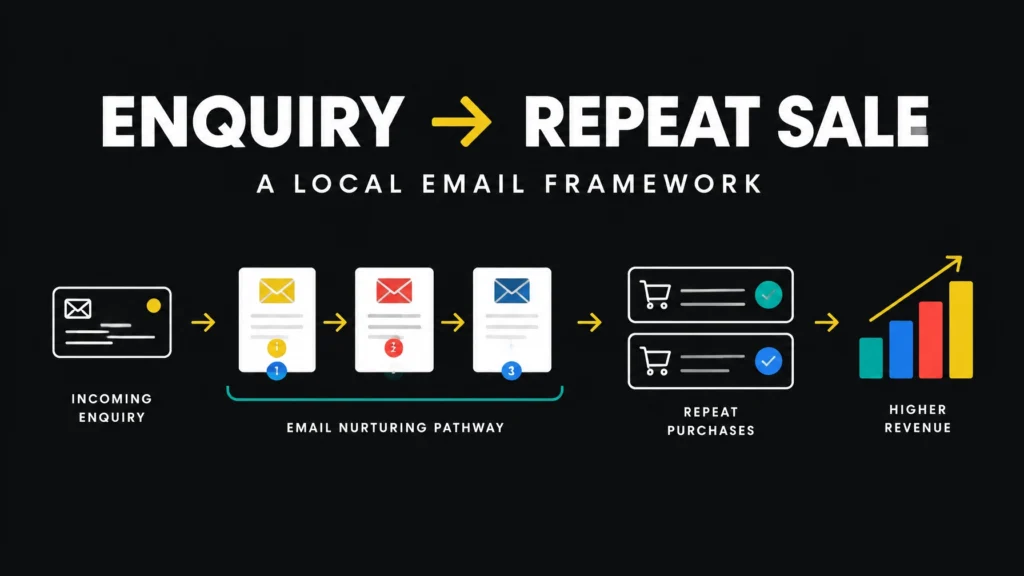
Fresh enquiries. Quiet inboxes. Missed repeat sales.
If you run a small business in Reading, Slough, Maidenhead, Windsor, Bracknell, Wokingham, High Wycombe, Aylesbury, Milton Keynes, Beaconsfield or Marlow, you already know the pattern. Enquiries arrive, a handful convert, and the rest drift away while they compare options. Meanwhile, customers who bought once quietly never come back.
Sound familiar?
-
Enquiries arrive, but follow up depends on someone remembering.
-
Interested prospects go quiet while they compare options or wait for the right moment.
-
Customers buy once, then hear nothing useful from you again.
-
Your team sends occasional campaigns, but cannot tell whether they lead to another sale.
Email marketing can help close those gaps. Not by sending more messages to everyone. By sending useful messages at the right point in each customer relationship, then measuring whether they lead to revenue.
WHAT A NURTURE SEQUENCE MEANS
Nurture sequence
/ˈnɜːtʃə ˈsiːkwəns/ noun
A planned series of emails sent in response to a person’s action, needs or customer status. Each message helps them take a sensible next step.
No jargon policy: we explain what we are doing, why it matters and how we will measure it. If an email does not help a customer or support a commercial outcome, it does not belong in the sequence.
START WITH THE CUSTOMER JOURNEY
Before writing emails or choosing software, map what happens between first enquiry and next purchase. A furniture retailer in Maidenhead and a plumbing business in Aylesbury will have different buying cycles. The framework should fit the decision, not force every customer into the same timetable.

For each journey, answer four questions:
- What did the person ask for or buy?
- What information would help them decide or get more value?
- What is the most useful next action?
- How will we know if they took it?
For a local retailer, the next step might be product care advice followed by a relevant accessory offer. For an accountancy firm in High Wycombe, it could be a useful guide after an initial consultation, then a reminder ahead of a key reporting date. A home improvement company near Windsor might share preparation advice after a quote and check in once the work is complete.
These messages are not just a sequence of promotions. They are a planned service that keeps your business useful after the first contact.
BUILD A SIMPLE FIVE PART FRAMEWORK
1. WELCOME THE ENQUIRY
Send an immediate confirmation when someone requests information, books a consultation or signs up to hear from you. Make clear what happens next and when they can expect a reply.
If a decision takes longer, follow up with one or two genuinely useful messages. Answer common questions, explain what is included and show how to take the next step. Avoid sending the same sales pitch repeatedly.
2. HELP THEM MAKE A DECISION
Use what you know about the enquiry to make follow up relevant. A person asking about a particular service should not receive a generic list of everything you sell.
For a business serving Berkshire and Buckinghamshire, relevance can be practical. Refer to the service they asked about, their preferred location or the type of job they described. Keep personalisation accurate and proportionate. If you do not know something, do not pretend you do.
3. FOLLOW UP AFTER THE SALE
A purchase is the beginning of the customer relationship, not the end of the marketing job.
Send a timely thank you, clear instructions or helpful advice that makes the product or service easier to use. Then check in at a point that makes sense. A customer who has just had a boiler serviced needs different follow up from someone who bought a birthday gift.
A useful sequence might be:
- Immediately: confirmation and the next practical step.
- After delivery or completion: helpful instructions or care advice.
- A little later: a short check in or request for feedback.
- At the expected next need: a relevant service reminder or complementary offer.

4. CREATE A REASON TO RETURN
Use purchase history and timing to identify a helpful next offer. This could be a refill reminder, a seasonal service, a related product or a repeat booking. The point is not to discount by default. It is to make the next purchase convenient and relevant.
A salon in Marlow might remind a customer when their next appointment is due. A retailer in Bracknell could recommend an item that complements a previous purchase. A professional service firm might check in before a customer’s next planning or renewal period.
Make the offer specific. Explain why it is relevant and give the customer a clear way to act.
5. WIN BACK CUSTOMERS WHO HAVE GONE QUIET
Some customers will not return straight away. Set a sensible period based on the normal buying cycle, then send a brief message that gives them a reason to re-engage. A new service, a useful update or a simple invitation to book may be more appropriate than an automatic discount.
If they do not respond, reduce the frequency of messages or stop sending them. Protecting trust matters more than chasing one extra click.
MEASURE THE SECOND SALE, NOT JUST THE OPEN
An email open can be a useful indicator, but it does not prove that the campaign generated revenue. For context, the DMA Email Benchmarking Report 2025 reports a 35.9% average open rate and a 2.3% unique click rate across its UK dataset. Those are sector averages, not targets for your business. Open rates can also be distorted by privacy features, so judge performance using actions and sales as well.
Track:
- Repeat purchase rate over a defined period.
- Revenue and, where possible, gross margin from each sequence.
- Time between a customer’s first and second purchase.
- Clicks and conversions from each email.
- Unsubscribes and complaints.
Compare like with like. A customer who buys every month should not be measured against one who hires you for a major project every few years.
Automated emails are worth testing because they respond to customer behaviour rather than relying on a campaign calendar. In its 2025 ecommerce dataset, Omnisend reported that automated emails generated 37% of email attributed sales from just 2% of email volume. Treat that as a vendor's view of their own customers, not a promise for yours. It is a reason to test relevant customer journeys, then use your own results to decide what works.

MAKE THE FRAMEWORK WORK FOR YOUR BUSINESS
Start with one valuable journey, not a dozen half finished automations. Choose the gap that is costing you most: enquiries that go quiet, customers who never book again, or repeat purchases that happen less often than they should.
Then:
- Agree what the sequence should help the customer do.
- Set a timing that matches the decision or purchase cycle.
- Write each email to answer one clear customer need.
- Check that contacts have the right permission to receive marketing.
- Review results and improve the sequence based on sales, not assumptions.
If your sales team and your marketing efforts are pulling in different directions, fix that first. Our guide to marketing and sales alignment explains how to get both working from the same plan.
A practical first test could be a welcome sequence for new enquiries, followed by a post purchase check in and a timely repeat offer. Make one change at a time so you can see what improves the outcome.
At HUDL, our email marketing service covers automated sequences, nurture journeys and campaigns tied to commercial goals. We work with small businesses across Berkshire and Buckinghamshire, from Reading and Slough to Aylesbury and Milton Keynes. We do not just advise. We take ownership of the work and will not recommend an approach unless we believe it can deliver.
TURN MORE ENQUIRIES INTO LASTING CUSTOMERS
You do not need to send more emails for the sake of it. You need a clear customer journey, useful follow up and a way to see whether it is generating repeat revenue.