Busy teams. Shifting markets. Bigger decisions.
01 Your agency delivers campaigns, but you are not sure what changed for the business.
02 You get polished work, but it is difficult to connect it to customer behaviour or commercial progress.
03 You need a partner who can adapt when the market, your offer or your priorities change.
Sound familiar?
For small businesses across Berkshire and Buckinghamshire, the choice between a growth marketing agency and a traditional agency is not about choosing modern over old fashioned. It is about choosing a way of working that fits your goals, your customers and your capacity.
START WITH THE DIFFERENCE
Growth marketing
/ɡrəʊθ ˈmɑːkɪtɪŋ/
A way of improving business growth by linking marketing activity to commercial goals, then learning and adapting as you go.
Traditional marketing agency
A partner that often plans and delivers defined campaigns or services, such as brand work, creative, public relations, media or content. The exact offer varies by agency.
These are useful descriptions, not fixed rules. Some traditional agencies measure commercial outcomes closely. Some growth agencies focus too narrowly on short term results. The label matters less than the work, the measures and the accountability behind it.
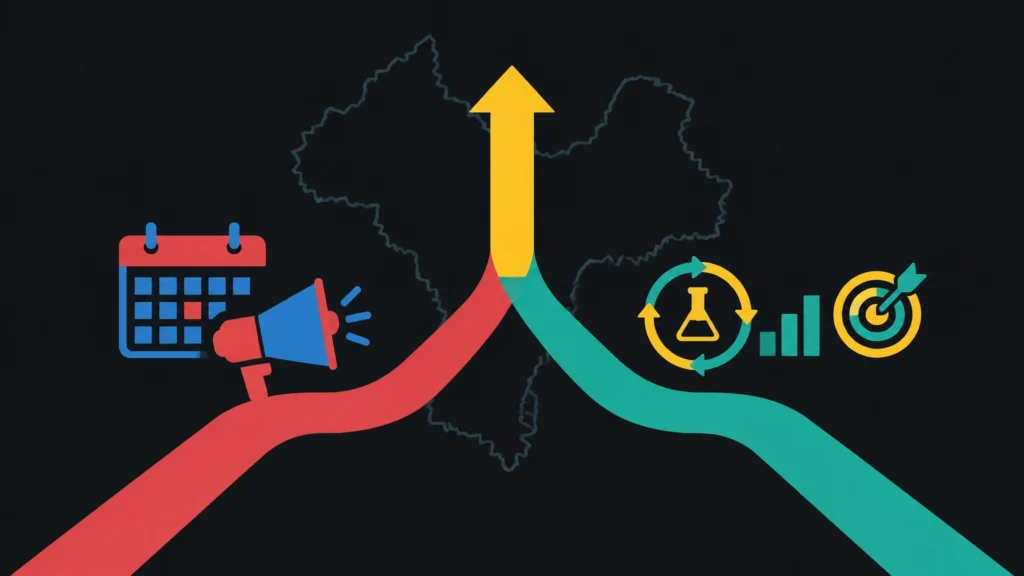
A growth approach usually looks across the customer journey and the business systems that support it. That may include positioning, channel choices, campaign delivery and measurement. A traditional approach often starts with a specific brief and delivers the agreed campaign or specialist service.
Neither model is automatically right for every business.
TWO WAYS OF ORGANISING THE WORK
A traditional agency engagement may begin with a defined task: launch a campaign, refresh a brand, produce a set of creative assets or manage a particular channel. The agency agrees the work, builds it and reports on delivery and response.
A growth agency is more likely to begin with a commercial question. For example: why are suitable customers not choosing us, or where could we make the customer experience clearer? The work then tests possible answers and adjusts based on what happens.

The distinction is not “creative versus numbers”. Strong marketing needs both. It is the starting point and the way decisions are made that tend to differ.
Consider a local professional services firm looking to reach more customers in Reading, High Wycombe or Marlow. A traditional brief might commission a campaign around a new service. A growth brief might ask which customer group is the best fit, what is stopping them from enquiring, and how the firm will learn whether its message is working.
The second brief may still involve a campaign. It simply connects that campaign to a wider business question.
WHAT THE EVIDENCE CAN AND CANNOT TELL YOU
The Department for Business and Trade’s 2025 research found that digital technology adoption among UK small and medium sized businesses varied by survey method. It reported adoption or purchase by 94% of businesses in its online survey and 79% in its telephone survey. The report also found that over 90% of online respondents who had adopted technology reported a positive impact.
That research is about business technology, not agency performance. It does not show that a growth agency will outperform a traditional agency. It does show why the tools behind modern marketing deserve practical attention. They should support better decisions and smoother work, not become a project in their own right.
Read the Department for Business and Trade research on technology adoption among UK SMEs.
The IAB UK report on digital advertising and SMEs notes that 72% of SMEs in its research spend below £5,000 a year on digital advertising. This is digital advertising spend, not a complete marketing budget. It is a reminder that many smaller firms need clear priorities and a sensible way to judge results.
WHEN A GROWTH APPROACH MAY FIT
A growth marketing agency may suit you if:
- Your business has a clear commercial goal, but the route to achieving it is uncertain.
- You need to understand which audience, message or channel deserves more attention.
- Your marketing includes several moving parts that need to work together.
- You want to make decisions from evidence, rather than continuing with a plan simply because it is familiar.
- You need a partner who can help shape the approach and take responsibility for putting it into practice.
Growth marketing is not a promise of instant results. It needs time to gather useful evidence. It also needs access to the right people, information and decisions inside your business.
WHEN A TRADITIONAL AGENCY MAY FIT
A traditional agency may be the better choice if:
- You have a clear strategy and need expert delivery for a defined project.
- Your immediate need is a specialist skill, such as a brand refresh, public relations or a major creative campaign.
- Your team can manage the wider commercial plan and coordinate suppliers.
- You already know what success should look like and can brief it clearly.
A specialist agency can be a strong partner. The risk is not using a traditional model. The risk is commissioning work without agreeing how it should support your business.
A PRACTICAL CHECK BEFORE YOU CHOOSE
Before appointing any agency, ask these questions:
-
What business outcome are we working towards?
Be specific. “More growth” is a direction. A defined customer, service or commercial objective gives the work a clearer purpose. -
What will the agency own?
Agree responsibilities for planning, delivery, review and next steps. Ask what the agency will do when early signs are weak. -
How will we review progress?
Set a regular review point. Include measures that relate to your objective, not only a list of completed tasks. -
What will you need from us?
Be realistic about the time your team can give. A good plan should work with your capacity, not assume you have a large in house marketing department. -
Can the agency explain the plan plainly?
You should understand what is happening, why it matters and what would lead to a change in direction.

THE BEST FIT MAY BE A BLEND
A firm in Buckinghamshire might need specialist creative work for a launch, while also needing a joined up plan to learn from customer response. A Berkshire business might need a focused campaign alongside a partner who can help connect its wider marketing activity to commercial priorities.
There is no need to force every requirement into one agency model. You can commission specialist work while keeping a clear owner for the wider direction. What matters is that the work joins up and that everyone knows how success will be judged.
At HUDL, we work with businesses at the intersection of strategy, performance and operations. Our approach combines planning with hands on delivery where it makes sense. We take ownership of the work we agree to do, and we will not recommend an activity if we do not believe it can help.
For more on how a practical partner can combine strategic thinking with delivery, read our guide to what a marketing consultancy does.
NO JARGON. CLEAR OWNERSHIP.
We have a no jargon policy. If an idea cannot be explained in straightforward language, it is not ready to guide a business decision.
One useful term is return on investment, often shortened to ROI. It means comparing what an activity returns with what it costs. The right way to calculate it depends on the business and the objective. It should not be reduced to a tidy number without explaining what has been counted.

Your agency should be able to explain what it owns, what you own and what evidence will guide your next decision. That is true whether you choose growth marketing, a traditional agency or a combination of the two.
CHOOSE THE WAY OF WORKING THAT FITS
For Berkshire and Buckinghamshire SMEs, the right choice starts with the problem, not the agency label. Choose a defined specialist partner when you know the task. Consider a growth partner when the task itself is still unclear or when different parts of your marketing need to work together.
If you are weighing up your next step, talk to HUDL. Together, we can look at your commercial goals, understand what is getting in the way and agree what is worth doing next.