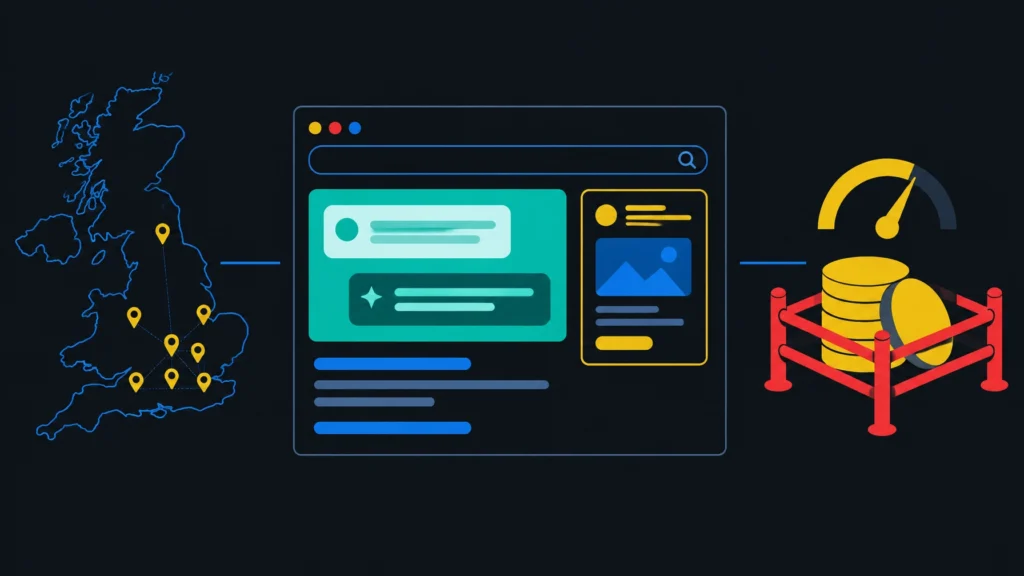
New placements. Blended reporting. Real budget decisions.
-
Your Google Ads spend is steady, but lead quality is slipping.
-
You can see clicks and conversions, but not which parts of Search are driving them.
-
You are being asked to trust a new advertising placement before you can measure its return.
Sound familiar? For small businesses in Reading, Slough, High Wycombe, Maidenhead, Wokingham, Bracknell and Aylesbury, these are sensible concerns. Google’s AI search ads have started appearing in the UK, and the honest answer is this: they are not inherently bad for your budget, but right now you cannot measure their individual contribution.
That does not mean you need to panic or switch everything off. It means you should tighten your measurement and lead checks before the rollout reaches your campaigns.
WHAT IS COMING TO THE UK, AND WHEN?
On 28 October 2026, Google announced that ads in AI Mode are expanding to more than 10 additional English speaking countries. Australia, Canada, India, Kenya, Malaysia, New Zealand, Nigeria, Pakistan, the Philippines and Singapore are included. Brazil, Mexico and the United Kingdom are listed as upcoming markets for Q4 2026.
Google has not announced a specific UK launch date. But the placement has effectively arrived. Tracking firm Adthena started monitoring UK AI Mode the day after the announcement and found sponsored placements already showing under AI answers by early November. Many of the advertisers appearing had not set out to buy the placement. Their existing campaigns simply qualified.
So treat this as live in your account, not a change waiting to happen.
AI Mode is Google’s conversational search experience. A user can ask a detailed question, explore options and refine what they need. Ads may appear within or alongside the AI response when Google considers the conversation commercially relevant. Ads in AI Overviews, the AI generated summaries on Search, are another part of the wider change.
AI search is already part of everyday behaviour. AI Overviews have been reported on more than 40% of US searches. That figure is about search visibility, not a promise that 40% of your UK customers will see an ad.
One useful distinction: multiturn ads, which can appear on follow up questions in an AI Mode conversation, are US only so far. That means upper funnel commercial questions are beginning to carry ads there before they do in the UK.
Google says existing eligible Search, Shopping and Performance Max campaigns can participate, and it has been testing exact and phrase match keywords serving text ads in AI Mode where intent is explicit. There is no separate campaign setting to join or leave AI Mode placements. In practice, that means you cannot switch off AI Mode ads while keeping the rest of your Search activity unchanged. Google also says advertisers cannot opt out of AI generated “what customers love” review summaries shown in Search ads. These snippets are enabled by default.
For the current details, see Google’s guide to ads in AI powered Search.

WHAT GOOGLE WRITES ON YOUR BEHALF
In the first UK examples, each ad block opened with a short line written by Google, not by the advertiser. One example reframed a searcher’s question into a single sentence above the listings. That line does not appear in Google Ads, so you cannot review it, edit it or test it.
AI Mode builds its ads from what you already publish: your campaign assets, your feed and your landing pages. That makes your website copy part of your ad copy, whether you intended it to be or not.
For a local business, the practical response is plain and specific landing pages. Say what you do, which towns you cover and who you do it for. A page that names Reading, Newbury, High Wycombe or Aylesbury and describes the actual service gives the system something accurate to work with. Vague slogans give it nothing, and it will write around the gap.
It is also worth reading your asset groups and headlines for claims you would not want repeated back to a customer.
WHY THE REPORTING GAP MATTERS
Attribution (at-tri-BYOO-shun, noun): the method used to connect marketing activity with an enquiry, sale or other result.
Google folds AI Mode impressions, clicks, conversions and cost into standard campaign reporting. Search terms from AI experiences are included in aggregate too. There is no separate AI Mode breakdown, and the search terms shown may only approximate what a person intended.
So you can review your campaign’s overall CPA, or cost per acquisition, and ROAS, or return on ad spend. But you cannot calculate an AI Mode specific CPA or ROAS from Google Ads reporting.
A recent Search Engine Land study found that AI search activity is nearly invisible in Google Ads search terms reports. That makes a simple before and after comparison tricky. If your campaign changes after the UK rollout, the combined data will not tell you whether AI Mode caused the change.
For a Berkshire SME with limited spend, that uncertainty matters. An AI placement might introduce your business to someone still researching. That could support a later enquiry, but it might also generate clicks from people who are not ready to buy or are not a good fit. Without separate reporting, the campaign totals do not reveal which explanation is right.
HOW TO PROTECT YOUR BUDGET BEFORE THE ROLLOUT
You cannot isolate AI Mode with a setting. You can make sure your campaigns, tracking and follow up process are strong enough to spot problems early.
1. CHECK THAT YOUR CONVERSION TRACKING IS TRUSTWORTHY
Review your Google Ads and GA4 setup. Test that a genuine enquiry is recorded once, and that button clicks or page views are not accidentally counted as leads. If you use a CRM, check that campaign information follows the enquiry through to a qualified opportunity and, where possible, revenue.
A form submission is not automatically a good lead. The useful measure is whether it represents a genuine prospect your team can serve.
2. WRITE DOWN WHAT COUNTS AS A GOOD LEAD
Agree with sales what makes an enquiry relevant. For example, does the person live in your service area? Are they asking about a service you provide? Can they be reached? Does the project fit your typical budget or timescale?
Ask the team to record the outcome of calls and form enquiries consistently. A weekly or fortnightly review can reveal a rise in irrelevant enquiries before it becomes a large budget problem.
For help making this process work across teams, see our guide to marketing and sales alignment.
3. REVIEW NEGATIVE KEYWORDS AND CAMPAIGN INTENT
Negative keywords help exclude searches that are clearly irrelevant. Review the terms you can see and add sensible exclusions based on your offer, service area and customer conversations. Keep in mind that reporting is incomplete, so a clean looking search terms report is not proof that every AI interaction was a good fit.
Where it makes sense, separate your tightly controlled, high intent campaigns from broader campaigns. That will not create an AI Mode report, but it can make changes in performance easier to interpret. Keep the structure manageable for your budget and team.
4. SET BUDGET LIMITS AND WATCH FOR UNUSUAL TRAFFIC
Set campaign budgets according to what your business can afford to test, not what an automated recommendation suggests you spend. Check spend and lead quality regularly, especially if you use AI Max for Search.
A Lunio analysis of retail campaigns found invalid traffic in AI Max Search campaigns rose from 2.46% in Q4 2025 to 5.28% in Q2 2026. The study was observational, focused on retail, and does not prove that AI Mode ads themselves cause invalid traffic. AI Max and AI Mode are also different things. Still, it is a useful reminder to watch for unusual click patterns and enquiries that do not behave like real prospects. Read the study and its methodology.
On 12 November 2026, Google added an Invalid Traffic Overview Card to Google Ads. It shows the spend its systems say they saved you from invalid activity, plus any credits issued for invalid clicks or leads, and Google states that advertiser exposure to invalid leads fell by an average of 30% during 2026. Review it monthly beside your own enquiry records, so a platform figure is always checked against what actually reached your team.
5. USE A HUMAN SANITY CHECK
Once a month, review a sample of calls and contact forms with the people who handle them. Are the enquiries relevant? Are there repeated questions showing your ad or landing page has set the wrong expectation? Are there sudden changes in missed calls, spam or incomplete forms?
These checks are simple, but they give context that platform metrics cannot. Our guide to setting a UK SME marketing budget can also help you decide what is sensible to allocate to testing.

WHAT CHANGES ON 3 DECEMBER?
The Competition and Markets Authority (CMA) requires Google to give UK website owners clear engagement metrics for AI search features, including impressions, clicks and click through rates. The compliance deadline is 3 December 2026. The data is intended to help website owners understand how their pages perform in features such as AI Overviews and AI Mode, and it is expected to be separated from ordinary organic results rather than blended into one total. Google has not yet published the format, so treat the details as pending. Further page level controls for publishers are scheduled for March 2027.
That is a welcome step towards better visibility. But be clear about what it does and does not provide. The CMA requirement concerns website owner engagement data. It does not, by itself, promise a separate report showing UK advertisers the spend, conversions or return from ads in AI Mode.
When the new website metrics arrive, look at them alongside your own analytics, CRM records and sales feedback. They can help explain how people engage with your site from AI features. They will not replace reliable tracking of paid leads and revenue.

THE BOTTOM LINE FOR BERKSHIRE AND BUCKINGHAMSHIRE SMES
Google’s AI ads are not automatically a budget threat. They could help your business reach people exploring a need, comparing options or looking for a local provider. The issue is that you cannot yet isolate their contribution in Google Ads.
So do not assume the placements are working just because campaign totals look healthy. And do not assume they are failing because the reporting is imperfect. Keep budgets within agreed limits, verify your conversion tracking, and judge enquiries by quality as well as quantity.
The companies best placed to make a sound decision will be those that know what a qualified lead looks like and can trace it through to a commercial outcome. If you are weighing up whether to change your paid search activity, our guide to Google Ads versus Meta for Berkshire small businesses may help clarify each channel’s job.
At HUDL, we work with small businesses across Berkshire and Buckinghamshire to align marketing with commercial goals. We bring strategy, paid media and measurement together, and we take ownership of the work we agree to do. Our no jargon policy means we will explain what the data can show, what it cannot show and what to do next.
WANT TO KNOW WHETHER YOUR AD BUDGET IS WORKING?
BOOK A MARKETING CONSULTATION AT HUDL.GG
Let’s review your tracking, lead quality and campaign structure together, then decide what makes sense for your business.